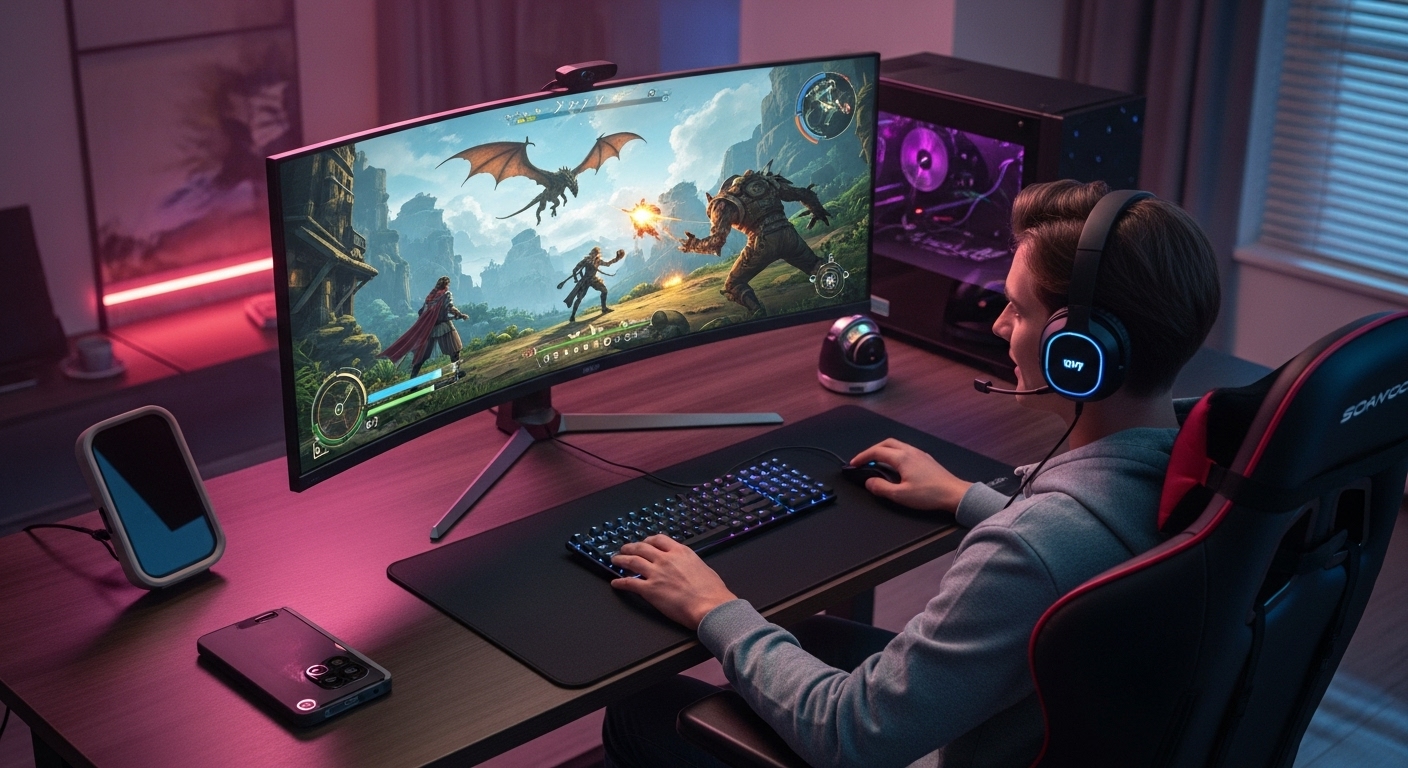
Gaming has become an undeniable part of modern culture, a global phenomenon that has evolved far beyond its humble beginnings. What was once a simple form of entertainment has blossomed into an entire universe, with its own communities, industries, and even career opportunities. Whether you’re a casual gamer or a competitive esports athlete, gaming has cemented its place in the hearts of millions. In this blog post, we’ll take a deep dive into the world of gaming—tracing its origins, examining its cultural impact, analyzing its technological advancements, and predicting where the industry is headed in the future.
The Origins of Gaming: From Pixels to Powerhouses
The story of gaming began in the 1950s and 1960s, but it wasn’t until the 1970s that gaming truly started to take form in a way that we would recognize today. The first arcade games like Pong—a simple simulation of table tennis—offered a glimpse into what would become an entire entertainment ecosystem. Though primitive by today’s standards, Pong became a sensation, and it helped establish video games as a potential form of entertainment beyond traditional sports or board games.
In the early years, gaming was mostly confined to arcades, and video games were more about achieving high scores than anything else. Over time, the technology evolved, and in the 1980s, home consoles began to make their way into living rooms. Systems like the Nintendo Entertainment System (NES) and Sega Genesis allowed players to experience games like Super Mario Bros. and Sonic the Hedgehog in their homes, ushering in a golden age for both console gaming and the gaming industry as a whole.
This era also saw the rise of beloved gaming franchises that would leave an indelible mark on the industry, from The Legend of Zelda to Final Fantasy, games that still hold relevance today. These early games helped define the core aspects of gaming, including platformers, action-adventures, and role-playing games (RPGs).
The Impact of Technology on Gaming Evolution
As technology advanced, so did the capabilities of video games. The 1990s introduced 3D graphics and new forms of gameplay that revolutionized the gaming experience. Games such as Doom and Quake were some of the first to deliver a 3D experience, while the Sony PlayStation pushed forward the boundaries of gaming with titles like Final Fantasy VII, Crash Bandicoot, and Gran Turismo. These games weren’t just about how they looked—they also introduced players to deep stories, character development, and immersive worlds.
The early 2000s saw further advancements in both hardware and software, with the rise of high-definition graphics and massive, sprawling open-world environments. Titles like Grand Theft Auto III and Halo changed the landscape by adding immersive storytelling, realistic physics, and advanced AI (artificial intelligence) to games. The PlayStation 2, Xbox, and later the PlayStation 3 and Xbox 360 raised the bar even higher, offering not just better graphics but also online multiplayer modes and the ability to download additional content.
Today, gaming has reached unprecedented levels of realism, with ultra-high-definition graphics and the rise of ray tracing technology that makes virtual worlds look more lifelike than ever. Games like The Last of Us Part II, Red Dead Redemption 2, and Cyberpunk 2077 have redefined what we can expect from a game’s visual quality and attention to detail. Not only do these games feature photorealistic environments, but they also offer dynamic and reactive worlds where the choices players make matter.
Multiplayer Gaming and the Rise of Online Communities
One of the most significant changes in the gaming landscape over the past two decades has been the shift toward multiplayer gaming. Whereas gaming used to be a solitary experience, the rise of online services like Xbox Live, PlayStation Network, and Steam has created a vibrant global community of players. Games like World of Warcraft, League of Legends, Fortnite, and Apex Legends have thrived due to their multiplayer elements, fostering communities and friendships that span the globe.
Online multiplayer games are now some of the most popular titles on the market, allowing players to compete with or cooperate alongside friends, strangers, or even professional esports athletes. The internet has helped shape gaming into a social experience, with players forming clans, guilds, and teams to tackle in-game challenges together. This sense of belonging and camaraderie has played a significant role in gaming’s continued growth.
Moreover, esports have taken off in a major way, becoming a legitimate form of competition akin to traditional sports. With games like Counter-Strike, Overwatch, and Dota 2, the esports scene has grown exponentially. Tournaments offer multimillion-dollar prize pools and attract millions of viewers worldwide, all contributing to a growing professional industry where players can make a living by competing at the highest level. Major esports events are broadcast on television and through streaming platforms like Twitch, creating a spectacle that draws in fans much like any other major sporting event.
The Evolution of Game Genres
One of the most interesting aspects of gaming’s evolution has been the sheer diversity of genres that have emerged over the years. Early games were often simple in design, offering basic mechanics and straightforward gameplay. As time went on, however, game developers began to experiment with new ideas, resulting in the creation of a wide range of genres that cater to all types of players.
- Action and Adventure Games
Action-adventure games have always been a staple of gaming, blending fast-paced action with exploration and puzzle-solving elements. Series like The Legend of Zelda and Uncharted have long captured the hearts of gamers by combining thrilling combat with intricate worlds and engaging narratives. - Role-Playing Games (RPGs)
RPGs have been another driving force in gaming’s evolution, with iconic franchises like Final Fantasy, The Elder Scrolls, and Mass Effect offering players the chance to immerse themselves in epic stories. Modern RPGs often feature open-world exploration, complex character development, and player-driven decision-making. - First-Person Shooters (FPS)
The first-person shooter genre has exploded in popularity, thanks to games like Call of Duty, Halo, and Overwatch. These games place players in the shoes of a soldier or combatant, offering fast-paced action, teamwork, and competitive play. - Simulation Games
Simulation games like The Sims or SimCity let players experiment with virtual worlds, creating cities, managing relationships, or building complex systems. These games often appeal to those who enjoy a slower pace and a focus on creativity and strategy. - Horror Games
Horror games have grown in popularity, with titles like Resident Evil, Silent Hill, and Amnesia scaring players through psychological tension and jump scares. These games often blend storytelling with the thrill of survival, putting players in terrifying situations where every decision could mean life or death. - Strategy Games
Strategy games, including real-time strategy (RTS) and turn-based strategy (TBS), offer players the chance to manage resources, plan attacks, and outsmart their opponents. StarCraft, Civilization, and XCOM are prime examples of this genre’s enduring appeal.
The Role of Storytelling in Modern Games
Another major shift in gaming has been the increasing importance of storytelling. In the early days, most games had minimal narratives, and gameplay was the primary focus. But as technology improved and games became more complex, developers began to tell deeper, more engaging stories.
Today, games like The Last of Us, God of War, and Red Dead Redemption 2 are known for their rich narratives, which rival those found in movies and literature. These games blend cinematic presentation with interactive gameplay, allowing players to actively engage with the story in a way that was previously impossible. Players make choices that shape the direction of the plot, and in some cases, can even influence the ultimate outcome of the game.
This shift in focus has led to the emergence of “narrative-driven” games that emphasize character development, emotional depth, and moral dilemmas. Players are no longer just pressing buttons—they are participating in stories that have the power to evoke genuine emotion and reflection.
The Future of Gaming: What’s Next?
Looking ahead, the future of gaming promises to be even more revolutionary. One of the most exciting developments is the growth of virtual reality (VR) and augmented reality (AR), which are set to transform how we experience games. With VR headsets like the Oculus Rift and PlayStation VR, players can immerse themselves in digital worlds as though they are actually inside them, experiencing the game in 360 degrees.
Additionally, the rise of cloud gaming is poised to change how we access and play games. With services like Google Stadia and Xbox Cloud Gaming, players no longer need expensive hardware to play high-quality games. Instead, games are streamed directly to devices via the internet, allowing players to enjoy cutting-edge experiences without needing a powerful gaming PC or console.
As AI technology improves, it’s likely that we will see even more intelligent, reactive NPCs (non-playable characters) in games. These characters could dynamically respond to the player’s actions, creating truly unpredictable experiences. We may even see games that adapt to the player’s skill level, providing a more personalized gaming experience.
The rise of indie games will continue to be a force in the industry, with smaller studios creating innovative and experimental titles that push boundaries. These games often bring fresh ideas, unique art styles, and unconventional gameplay that challenge the status quo.